Seven days in a week, seven colours named in the rainbow, seven seas, seven wonders. Seven turns up so often that it is hard to tell where the habit started. One thing is clear: people like it.
- Favourite numberPicked by about 1 in 10
- Survey sizeAbout 44,000 people
- Runner-upThree
Key takeaways
- In an online survey run by mathematics writer Alex Bellos, seven was the most popular favourite number, chosen by about one person in ten.
- The seven-day week traces back to ancient astronomy, which counted seven moving lights in the sky.
- Seven may also stand out for plain arithmetic reasons: it doesn’t divide neatly into the other numbers people count on their fingers.
The world’s favourite number
In 2011 British mathematics writer Alex Bellos asked people online to name their favourite number and say why. By the time he published the results in 2014, about 44,000 people had answered. Seven came first with almost 10 percent of the votes, followed by three, eight and four. Odd numbers won overall.
It was not a scientific poll, and Bellos said so. But it matched what psychologists had long noticed: asked to pick a number between one and ten, more people choose seven than any other.
Seven lights in the sky
Ancient sky-watchers could see seven bodies moving against the fixed stars: the Sun, the Moon, Mercury, Venus, Mars, Jupiter and Saturn. Babylonian astronomy gave these seven special importance, and the seven-day week is usually traced to that tradition. In many European languages the days still carry their names: Sunday, Monday and Saturday in English; Mardi (Mars) and Mercredi (Mercury) in French.
The Seven Sisters
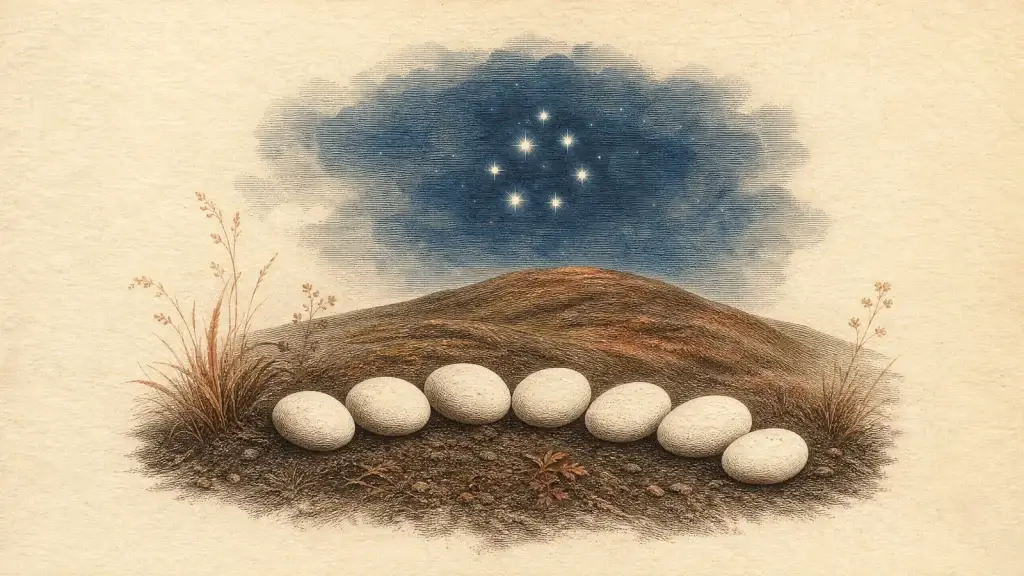
The Pleiades, a small cluster of stars in the constellation Taurus, has been called the Seven Sisters since ancient Greece, and many other cultures tell stories of seven sisters, brothers or maidens in the same spot of sky. Most people can see about six stars with the naked eye, which itself became part of the legends: one sister, the stories say, is hiding.
Seven in stories and belief
Seven runs through religious texts, fairy tales and proverbs: the seventh day of rest, seven years of plenty and seven of famine, the seventh son of a seventh son in Irish and British folklore said to have special gifts. Repetition breeds familiarity, and familiarity can feel like significance.
A number that stands apart
Bellos himself doubted that the planets explain everything. He suggested a simpler reason: of the numbers from one to ten, seven is the only one that can’t be multiplied or divided to give another number in that range. It feels separate, a little odd, and memorable. Dice players will add one more fact: when you roll two ordinary dice, seven is the most likely total.
So is seven lucky?
It is certainly loved. Whether it is lucky depends on whom you ask, and in some places it isn’t the favourite at all: in Chinese culture eight is the number of good fortune, because its name sounds like the word for prosperity. Seven’s luck is a story people tell, and a very old one.
Sources
- “And the World’s Favorite Number Is…”, Time, April 2014. time.com
- “Why do people love the number seven so much?”, Gizmodo. gizmodo.com
- Alex Bellos, The Grapes of Math, Simon & Schuster, 2014.
- Plus Magazine, University of Cambridge, “Why 7 is special”. plus.maths.org
Keep reading
 Where “Find a Penny, Pick It Up” Comes FromThe lucky-penny rhyme began as a rhyme about pins. Here is its history, the heads-up rule,…
 Lucky Charms Around the World: A Short Field GuideThe horseshoe, the four-leaf clover, the blue eye bead, the scarab, the beckoning cat and more:…
- Luck and FolkloreBrowse every guide in this section