Almost every culture has an object it keeps for luck or protection. Some hang over doors, some are worn, some sit on a shop counter. Here are eight of the best known, what each one is, and where the custom comes from.
- Oldest hereThe Egyptian scarab
- Most widely seenThe blue eye bead
- Common threadProtection more than fortune
Key takeaways
- Many “good luck” charms began as protective charms, meant to keep harm away rather than bring good things in.
- The same object can mean different things in different places, and rules about how to hang or carry it vary.
- Charms are cultural objects with long histories. Nothing here suggests they change events.
The horseshoe
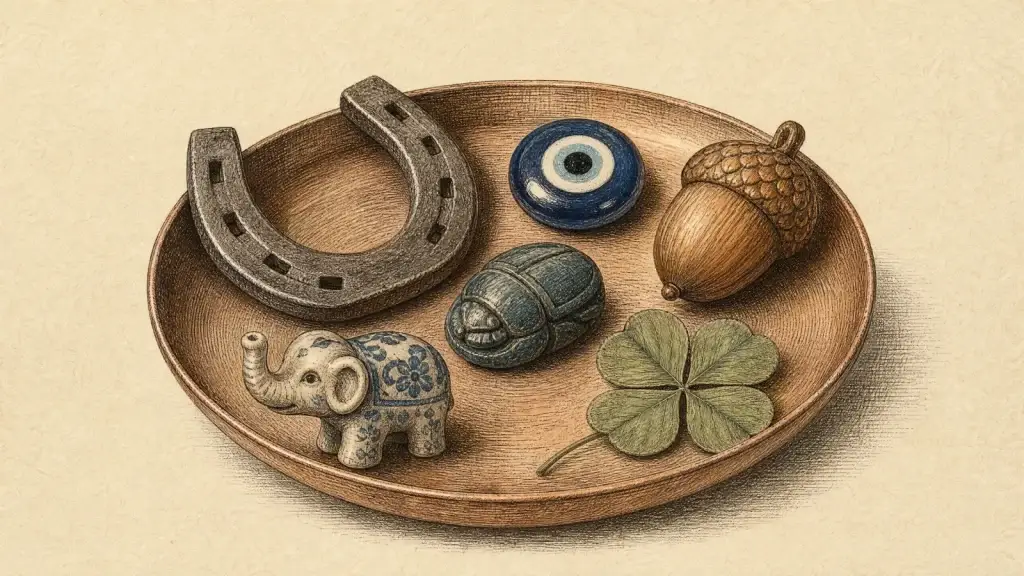
Horseshoes are made of iron, and iron has long been thought to keep away bad spirits in European folklore. An English legend tells of Saint Dunstan, a blacksmith before he became Archbishop of Canterbury, who nailed a shoe to the Devil’s hoof and released him only when he promised never to enter a house with a horseshoe over the door. Households still argue about which way up it should hang: points up so the luck doesn’t run out, or points down so it pours onto everyone who walks under it.
The four-leaf clover
Ordinary clover has three leaflets. A fourth is a rare variation, which is exactly why finding one felt special. In Irish and British tradition, the four leaves are sometimes said to stand for faith, hope, love and luck. Pressing one inside a book is a custom in its own right.
The blue eye bead
The blue glass eye, called a nazar in Turkey and known across Greece, the Middle East and the Mediterranean, is meant to guard against the “evil eye”, the old belief that envy or a jealous look can cause misfortune. It hangs in homes, cars and shops, and is pinned to baby clothes.
The scarab
In ancient Egypt the scarab beetle, which rolls balls of dung across the ground, was linked to Khepri, the god of the rising sun who was imagined pushing the sun across the sky. Scarab amulets carved from stone or faience are among the most common objects in museum collections of Egyptian antiquities, and they were made for thousands of years.
The acorn
The oak was the tree of thunder gods in Norse and other European traditions, and an acorn on the windowsill was said to keep lightning away. In Britain, the acorn-shaped pulls on old window blinds are often explained by this belief, though the story is told more often than it is documented.
The elephant
Small elephant figures, usually with the trunk raised, are kept as luck charms in many countries. The raised trunk is said to hold or scatter good fortune, and the custom of facing the elephant toward the front door is common. In India the elephant-headed god Ganesha, the remover of obstacles, gives the elephant a deeper meaning.
The beckoning cat
The maneki-neko, a ceramic cat with one paw raised, sits by the till in shops and restaurants in Japan and across East Asia. A raised left paw is traditionally said to invite customers, and a raised right paw good fortune. Several temples and shrines in Tokyo claim to be where the legend began.
The key
Keys appear in luck customs from Italy to Britain, often as symbols of opening doors or of the household itself. Small keys are given as charms at weddings and coming-of-age birthdays in some places.
Why people keep them
Charms are as much about memory as magic. A horseshoe from a grandparent’s barn or a blue bead bought on a holiday carries a story. That may be the best reason to keep one: not for what it promises, but for what it reminds you of.
Sources
- Iona Opie and Moira Tatem, A Dictionary of Superstitions, Oxford University Press, 1989.
- Carol Andrews, Amulets of Ancient Egypt, British Museum Press, 1994.
- Alan Dundes (ed.), The Evil Eye: A Casebook, University of Wisconsin Press, 1992.
Keep reading
 Where “Find a Penny, Pick It Up” Comes FromThe lucky-penny rhyme began as a rhyme about pins. Here is its history, the heads-up rule,…
 Why Seven Keeps Turning Up as a Lucky NumberSeven is the world's favourite number in one large survey. Here is the history behind it:…
- Luck and FolkloreBrowse every guide in this section