“Find a penny, pick it up, and all day long you’ll have good luck.” It is one of the best-known luck rhymes in the English-speaking world, and the name of this journal. But the oldest versions of the rhyme are not about pennies at all.
- Older version“See a pin and pick it up”
- In print by1870, in an American children’s magazine
- Common add-onHeads up for luck
Key takeaways
- The rhyme began with pins, which were once valuable household items, before pennies replaced them.
- Many versions carry a warning second half about leaving the pin, or the penny, on the ground.
- The “heads up only” rule is a later addition, and not every family keeps it.
- The U.S. Mint struck its last circulating pennies in November 2025, but the coins, and the custom, are still around.
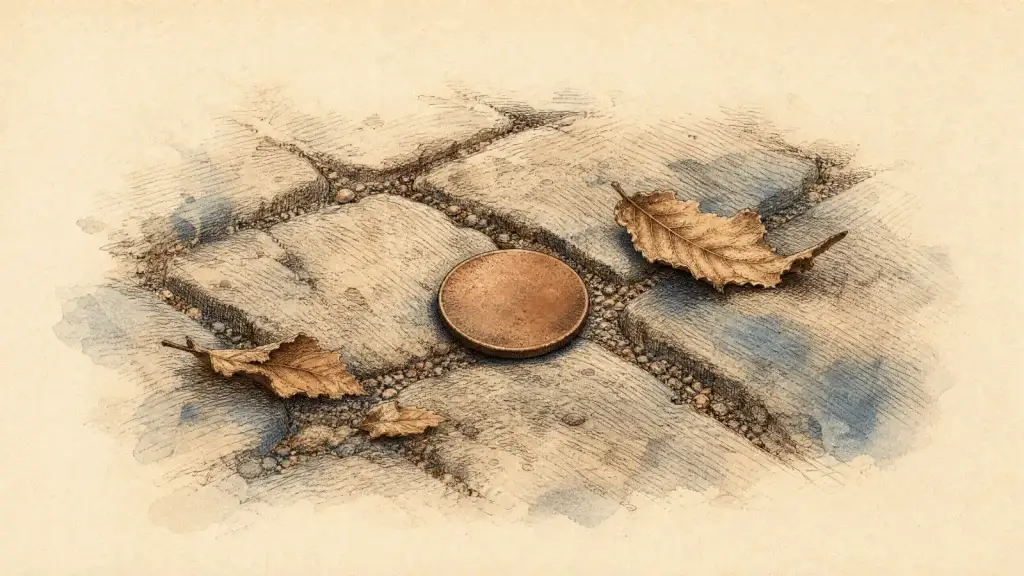
It started with a pin
The older rhyme goes “See a pin and pick it up, all the day you’ll have good luck.” It appears in collections of traditional nursery rhymes, usually with a second couplet that warns against walking past: “See a pin and let it lie, you’ll want a pin before you die,” or a gloomier “come to sorrow by and by.”
An American children’s magazine, Our Young Folks, printed the pin version in March 1870 in a story about a girl who would not pick up a pin. That is an early printed record, though the rhyme was almost certainly older in speech.
The pin made sense. Before machine-made pins were cheap, each one took real labour to make, and a household could not afford to waste them. A pin on the floor was worth stooping for. The “luck” may have begun as a nudge toward thrift: the person who picks up small things that are useful is the one who has them when they’re needed.
How the pin became a penny
At some point the penny took the pin’s place, at least in America. The swap is easy to understand. Pins became cheap and unremarkable, while a coin on the pavement still felt like a small gift. Many people who grew up with the penny rhyme say an older relative taught them the pin version, which suggests the change happened within living memory for some families.
The penny rhyme grew its own extensions. One common version adds “Give that penny to a friend, and your luck will never end,” turning the found coin into something to pass on.
The heads-up rule
Many people say only a penny found heads-up brings luck. A tails-up penny, in this version, should be turned over and left for the next person, so that they can have the luck instead. It is a kind and tidy rule, but it is a later layer: the old pin rhyme has no such condition, and plenty of families never heard of it.
Coins as luck around the world
The lucky penny belongs to a much bigger family of coin customs. British brides were told to carry “a silver sixpence in her shoe.” Coins are baked into New Year cakes in Greece and tossed into fountains in Rome. Across many cultures, a small coin has stood for “enough”: not riches, just the sense that there will be what is needed.
The last pennies
On November 12, 2025, the U.S. Mint held a ceremony in Philadelphia to strike its final circulating one-cent coins, ending 232 years of production. Pennies remain legal tender, and the Mint estimated about 300 billion were still in circulation, so there are plenty left to find. If anything, a penny on the pavement now feels a little more like a keepsake than it did before.
Keeping the custom
People keep the habit in small ways: a found penny dropped in a jar, tucked into a wallet, or left heads-up for someone else. None of it changes the odds of anything. The appeal is simpler: it is a moment of noticing, and a reason to bend down and pick up something someone else walked past.
Sources
- The Phrase Finder, “See a pin and pick it up”. phrases.org.uk
- American Dialect Society mailing list, February 2005, citing Mrs A. M. Diaz in Our Young Folks, March 1870. listserv.linguistlist.org
- United States Mint, “United States Mint Hosts Historic Ceremonial Strike for Final Production of the Circulating One-Cent Coin”, November 12, 2025. usmint.gov
- Iona Opie and Moira Tatem, A Dictionary of Superstitions, Oxford University Press, 1989.
Keep reading
 Lucky Charms Around the World: A Short Field GuideThe horseshoe, the four-leaf clover, the blue eye bead, the scarab, the beckoning cat and more:…
 Why Seven Keeps Turning Up as a Lucky NumberSeven is the world's favourite number in one large survey. Here is the history behind it:…
- Luck and FolkloreBrowse every guide in this section