Twelve signs, each with its own dates, element and character. The zodiac is one of the oldest ideas still in daily use, printed in newspapers and shared in conversation everywhere. Here is the standard list, and the history behind it.
- Signs12, each about a month
- RootsBabylonian astronomy
- ElementsFire, earth, air, water
Key takeaways
- Western astrology divides the year into twelve signs that start at the March equinox.
- Each sign is given an element, a “quality” and a ruling planet, and traditional traits follow from those.
- Because the Earth’s axis slowly wobbles, the signs no longer line up with the constellations they are named after.
- Sign dates shift by a day from year to year, so dates at the edges vary between sources.
Where the zodiac comes from
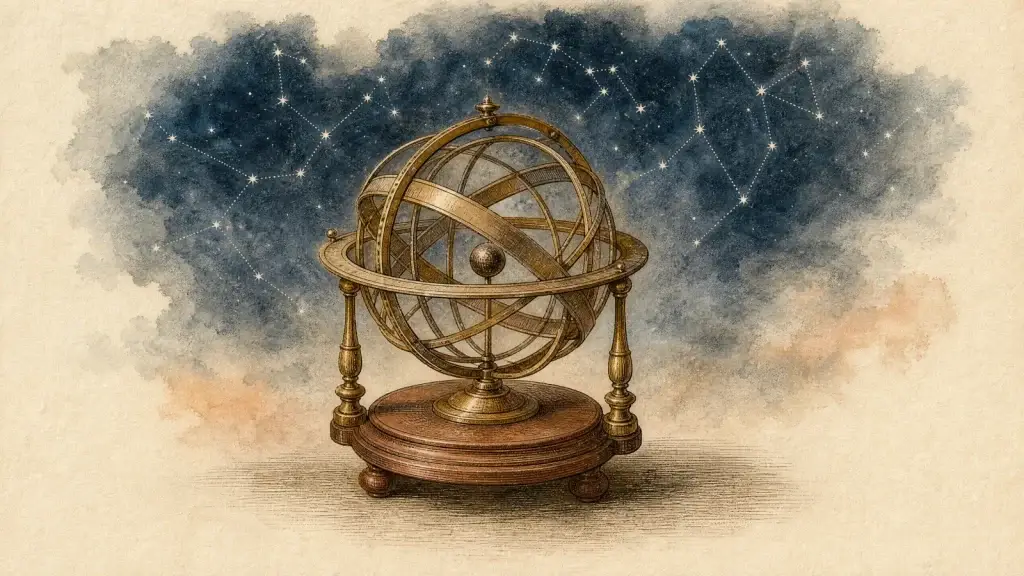
Babylonian astronomers tracked the path the Sun, Moon and planets follow across the sky, and by the fifth century BCE they had divided it into twelve equal parts named after constellations. Greek astronomers in Hellenistic Egypt combined that system with their own ideas, and the result became the astrology still used in the West. “Zodiac” comes from a Greek phrase meaning “circle of little animals”.
The twelve signs
| Sign | Dates | Element | Ruler | Traits tradition gives |
|---|---|---|---|---|
| Aries | Mar 21 – Apr 19 | Fire | Mars | Bold, direct, eager to start |
| Taurus | Apr 20 – May 20 | Earth | Venus | Steady, patient, fond of comfort |
| Gemini | May 21 – Jun 20 | Air | Mercury | Curious, quick, talkative |
| Cancer | Jun 21 – Jul 22 | Water | Moon | Protective, home-loving |
| Leo | Jul 23 – Aug 22 | Fire | Sun | Warm, proud, generous |
| Virgo | Aug 23 – Sep 22 | Earth | Mercury | Careful, practical, precise |
| Libra | Sep 23 – Oct 22 | Air | Venus | Fair-minded, sociable |
| Scorpio | Oct 23 – Nov 21 | Water | Mars (modern: Pluto) | Intense, private, determined |
| Sagittarius | Nov 22 – Dec 21 | Fire | Jupiter | Adventurous, frank, restless |
| Capricorn | Dec 22 – Jan 19 | Earth | Saturn | Disciplined, ambitious |
| Aquarius | Jan 20 – Feb 18 | Air | Saturn (modern: Uranus) | Independent, inventive |
| Pisces | Feb 19 – Mar 20 | Water | Jupiter (modern: Neptune) | Imaginative, sensitive |
Elements and qualities
Each element covers three signs. Fire signs are traditionally described as energetic, earth signs as practical, air signs as social and thoughtful, and water signs as emotional and intuitive. Signs are also given a “quality”: cardinal signs (Aries, Cancer, Libra, Capricorn) start each season, fixed signs sit in the middle, and mutable signs close it.
Why the signs don’t match the stars
The Earth’s axis wobbles slowly, completing a circle roughly every 26,000 years. Over the two thousand years since the signs were fixed, the starting point has drifted by nearly a whole sign. Most Western astrology uses the “tropical” zodiac, tied to the seasons rather than the stars, so a March birthday is still Aries even though the Sun is then in front of the constellation Pisces. Vedic astrology in India uses a “sidereal” zodiac tied to the stars, which is why its dates differ.
Astronomers also point out that the Sun passes through a thirteenth constellation, Ophiuchus, for a few weeks each year. It has never been part of the traditional twelve.
Who reads the signs
In a 2024 survey of nearly 9,600 U.S. adults, the Pew Research Center found that 27 percent said they believe in astrology, about the same share as in 2017, and that most people who consult it do so for fun.
Sources
- Pew Research Center, “30% of Americans Consult Astrology, Tarot Cards or Fortune Tellers”, May 21, 2025. pewresearch.org
- Nicholas Campion, A History of Western Astrology, Continuum, 2008–2009.
- Francesca Rochberg, The Heavenly Writing: Divination, Horoscopy, and Astronomy in Mesopotamian Culture, Cambridge University Press, 2004.
Keep reading
 The 22 Major Arcana in Plain WordsWhat each of the 22 major arcana tarot cards traditionally means, in plain words, with the…
 The Names of Each Full Moon and Where They Come FromWolf Moon, Snow Moon, Strawberry Moon: the traditional name for each month's full moon, what it…
- Cards and StarsBrowse every guide in this section