A tarot deck has 78 cards. Twenty-two of them, the major arcana, carry the pictures most people recognise: the Fool, the Lovers, the Tower, the Sun. Here is what each one traditionally means, in plain words, and how a card game became a tool for reflection.
- Deck size78 cards, 22 of them major
- First made15th-century northern Italy
- Best-known deckWaite-Smith, 1909
Key takeaways
- Tarot began in fifteenth-century Italy as a deck for playing card games, not for telling fortunes.
- Its link to the occult was invented in the late eighteenth century.
- The most familiar pictures come from the deck drawn by Pamela Colman Smith for Arthur Edward Waite, published in 1909.
- Card meanings are traditional keywords. “Death” almost never means death.
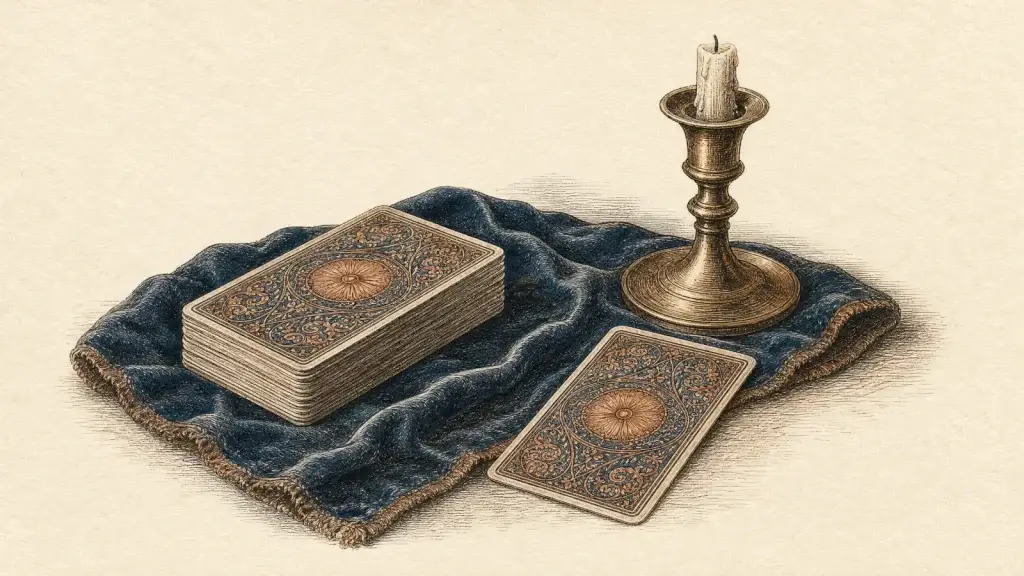
From card game to symbol
The first tarot decks appeared in northern Italy in the middle of the 1400s. Wealthy families commissioned hand-painted decks for a trick-taking game, and the extra picture cards were trumps, called trionfi. Some of these painted cards survive in museums today.
For three centuries tarot was simply a game. Then in 1781 the French writer Antoine Court de Gébelin claimed the cards hid the wisdom of ancient Egypt. There was no evidence for it, but the idea took hold. A few years later a Parisian known as Etteilla published instructions for reading the cards, and fortune-telling tarot was born.
In 1909 the occultist Arthur Edward Waite and the artist Pamela Colman Smith produced a deck, published by Rider in London, with a full picture on every card. It is often called the Rider-Waite or Waite-Smith deck, and most modern decks follow its designs. Waite also swapped the positions of Strength and Justice, so some decks number them differently.
The 22 cards
| No. | Card | Traditional keywords |
|---|---|---|
| 0 | The Fool | Beginnings, a leap into the unknown |
| I | The Magician | Skill, will, making use of what you have |
| II | The High Priestess | Intuition, things not yet revealed |
| III | The Empress | Nature, nurture, growth |
| IV | The Emperor | Structure, authority, order |
| V | The Hierophant | Tradition, institutions, teaching |
| VI | The Lovers | Union, a meaningful choice |
| VII | The Chariot | Drive, direction, control |
| VIII | Strength | Courage, patience, gentleness |
| IX | The Hermit | Solitude, reflection, searching |
| X | Wheel of Fortune | Cycles, chance, turning points |
| XI | Justice | Fairness, balance, consequences |
| XII | The Hanged Man | A pause, seeing things differently |
| XIII | Death | Endings and change, not literal death |
| XIV | Temperance | Moderation, blending, patience |
| XV | The Devil | Attachment, temptation, feeling stuck |
| XVI | The Tower | Sudden upheaval, a shock |
| XVII | The Star | Hope, renewal, calm after a storm |
| XVIII | The Moon | Uncertainty, dreams, things unclear |
| XIX | The Sun | Joy, clarity, warmth |
| XX | Judgement | Reckoning, awakening, a fresh start |
| XXI | The World | Completion, wholeness, arrival |
The Fool’s journey
Many readers see the major arcana as a story. The Fool sets out at card 0, meets teachers and trials along the way, faces endings and upheavals, and arrives at the World. Read in order, the cards make a picture of a life’s ups and downs, which may be why they still speak to people who don’t believe they predict anything.
How people use the cards today
About three in ten U.S. adults consult astrology, tarot or a fortune teller at least once a year, and most say they do it for fun, according to the Pew Research Center. Many people use a single card as a prompt: draw one, read its keywords, and ask how they might apply to the day ahead.
Sources
- Washington University in St. Louis, Becker Library exhibit on tarot history. beckerexhibits.wustl.edu
- Victoria and Albert Museum, “Tarot cards”. vam.ac.uk
- Arthur Edward Waite, The Pictorial Key to the Tarot, Rider, 1910.
- Pew Research Center, “30% of Americans Consult Astrology, Tarot Cards or Fortune Tellers”, May 21, 2025. pewresearch.org
- Michael Dummett, The Game of Tarot, Duckworth, 1980.
Keep reading
 The Twelve Signs: Dates and the Traits Tradition Gives ThemThe dates of the twelve zodiac signs, their elements and ruling planets, the traits tradition gives…
 The Names of Each Full Moon and Where They Come FromWolf Moon, Snow Moon, Strawberry Moon: the traditional name for each month's full moon, what it…
- Cards and StarsBrowse every guide in this section