Wolf Moon in January, Strawberry Moon in June, Hunter’s Moon in October. Each month’s full moon has a traditional name, and the list now turns up in weather reports and on calendars. Here are the names and the history of how one list became the standard.
- NamesOne for each month
- Made familiar byAmerican almanacs
- Special caseHarvest Moon, nearest the September equinox
Key takeaways
- The common list blends Native American, colonial American and older European names.
- Many Native nations had their own, different names, and each name usually covered a whole lunar month.
- Farmers’ almanacs printed in the twentieth century fixed the twelve names most people use today.
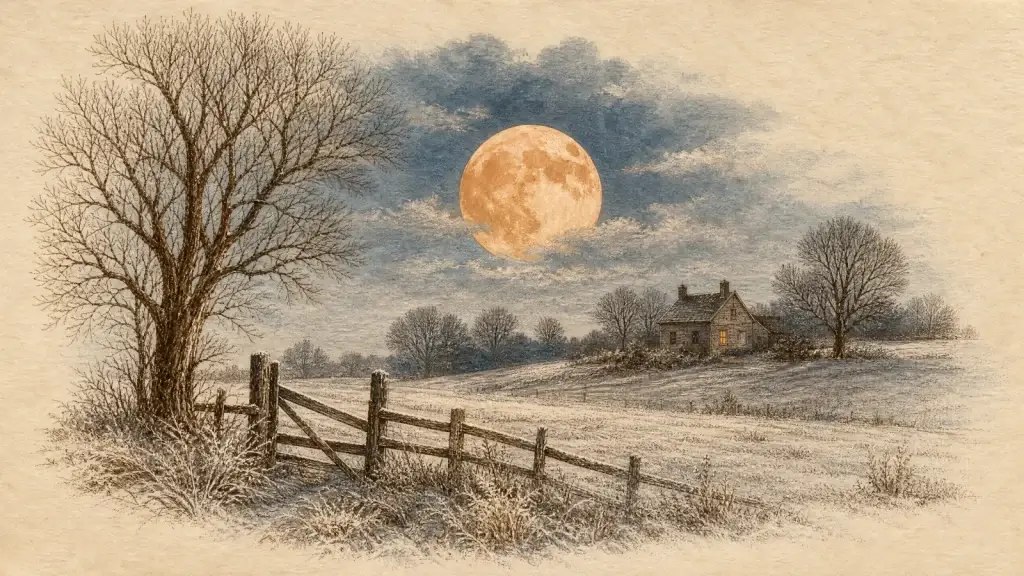
The twelve names
| Month | Name | What it refers to |
|---|---|---|
| January | Wolf Moon | Wolves heard in the deep of winter |
| February | Snow Moon | The heaviest snows |
| March | Worm Moon | Thawing soil, or beetle larvae leaving tree bark |
| April | Pink Moon | Early pink wildflowers such as creeping phlox |
| May | Flower Moon | Flowers in bloom |
| June | Strawberry Moon | Wild strawberries ripening |
| July | Buck Moon | New antlers on male deer |
| August | Sturgeon Moon | Sturgeon fishing in the Great Lakes |
| September | Corn Moon (or Harvest Moon) | Gathering the crops |
| October | Hunter’s Moon | Hunting before winter |
| November | Beaver Moon | Beavers busy before the freeze |
| December | Cold Moon | The long, cold nights |
Where the list came from
Many Native American nations named lunar months for what was happening in nature, and the names varied from nation to nation and language to language. In the eighteenth century the explorer Jonathan Carver recorded a list of moon names he attributed to Native peoples of the Great Lakes region; most of today’s twelve names overlap with his. Not every name on the modern list is Native, though: The Old Farmer’s Almanac notes that “Wolf Moon” is thought to have English origins.
In the twentieth century, farmers’ almanacs began printing one name for each month’s full moon. That list was repeated so often that it became the standard, and most people now meet these names in news stories about the month’s full moon.
The Harvest Moon
One name moves. By tradition, the Harvest Moon is the full moon closest to the September equinox. Most years it falls in September, but about every three years it lands in October, and that month’s full moon takes the name instead of the usual one.
The blue moon
Today “blue moon” usually means the second full moon in a single calendar month, which happens every two or three years. That meaning comes from a 1946 magazine article that misread an older almanac rule, under which a blue moon was the third full moon in a season that had four. Both meanings are now in use. Either way, the moon does not turn blue.
Watching the moon
Part of the pleasure of moon names is that they tie the sky to the season outside: snow in February, strawberries in June. They are an easy way to notice the year turning, and an invitation to step outside and look up.
Sources
- The Old Farmer’s Almanac, “Full Moon Names”. almanac.com
- History.com, “How the Full Moons Got Their Names”. history.com
- Jonathan Carver, Travels Through the Interior Parts of North America, 1778.
Keep reading
 The 22 Major Arcana in Plain WordsWhat each of the 22 major arcana tarot cards traditionally means, in plain words, with the…
 The Twelve Signs: Dates and the Traits Tradition Gives ThemThe dates of the twelve zodiac signs, their elements and ruling planets, the traits tradition gives…
- Cards and StarsBrowse every guide in this section