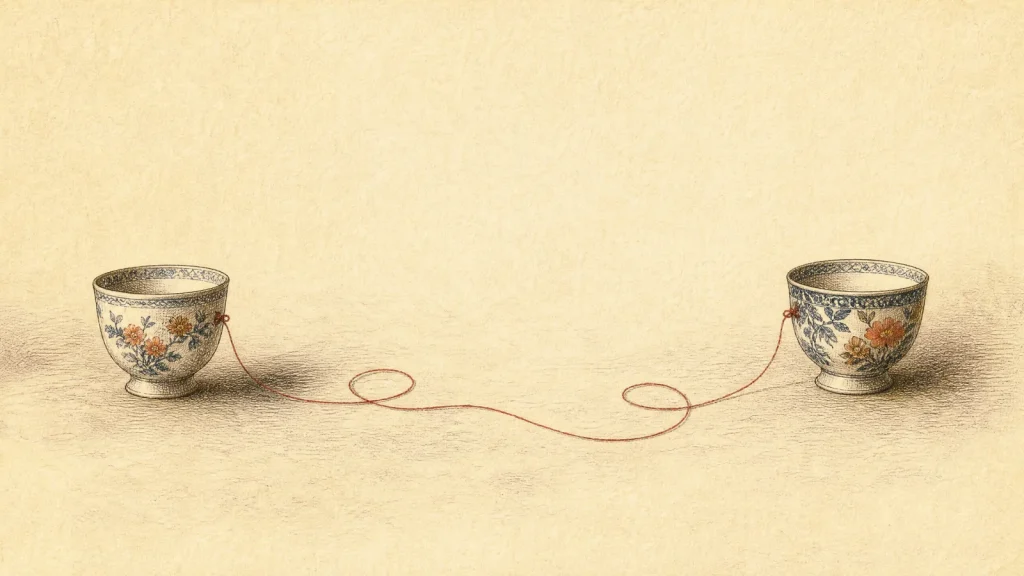
An invisible red thread ties two people together from birth. It may stretch or tangle, the story goes, but it never breaks. The legend comes from China, and it is one of several old stories about the one person someone is meant to meet.
- OriginTang dynasty China
- MatchmakerYue Lao, the old man under the moon
- Greek parallelPlato’s Symposium
Key takeaways
- In Chinese folklore, Yue Lao, “the old man under the moon”, ties a red thread between people destined to marry.
- The best-known version of the story is set in the Tang dynasty and appears in a collection of tales from that era.
- In Japan the thread is tied to the little finger; in China it was first said to be tied at the ankle.
- Ancient Greece had its own soulmate story, told in Plato’s Symposium.
The old man under the moon
Yue Lao, whose full name means “the old man under the moon”, is the Chinese god of marriage. He is pictured as an elderly man reading a book of marriages by moonlight, with a bag of red cord at his side.
The best-known tale is set in the Tang dynasty (618–907). A young man named Wei Gu, eager to find a wife, meets the old man one night and learns that his future wife is a little girl, then only three years old, whom he sees in the market with a poor old woman. Horrified, Wei Gu sends a servant to harm her, and the girl is left with a small scar between her eyebrows. Fourteen years later, Wei Gu marries a young woman who always wears a flower over her brow. She is that same girl. The thread could not be cut.
A Tang-era saying speaks of “feet linked by red cords”, and red string has been part of Chinese wedding customs for centuries.
The thread in Japan
The legend travelled to Japan, where it is known as akai ito, the red thread. There the thread is usually tied to the little finger, and it has become a familiar image in Japanese and East Asian stories, songs and films. Outside Asia the idea has spread widely, often without its origin.
Plato’s other halves
Ancient Greece told a different story. In Plato’s Symposium, written in the fourth century BCE, the comic playwright Aristophanes gives a speech about love. Humans, he says, were once round creatures with four arms, four legs and two faces. Zeus, worried by their strength, split each one in two, and ever since each half has searched for the other. Love, in his telling, is the name for that search to be whole again.
Aristophanes’ speech is a comic story inside a philosophical dialogue, and Plato does not present it as his own view. But the image of the “other half” has outlived nearly everything else in the book.
Bashert
In Jewish tradition, the Yiddish word bashert means “destined”, and is used of the person someone is meant to marry. A passage in the Talmud says that forty days before a child is formed, a heavenly voice announces whom that child will marry.
Why soulmate stories last
Each of these stories says something comforting: that the right person exists, that the connection is already there, and that the twists of life don’t break it. Whether you take them as truth or as poetry, they are some of the oldest love stories people still tell.
Sources
- “Red thread of fate”, Wikipedia. en.wikipedia.org
- David K. Jordan, “The Old Man in the Moonlight”, Chinese folk tales collection, University of California, San Diego. pages.ucsd.edu
- Plato, Symposium, 189c–193d (Aristophanes’ speech).
- Babylonian Talmud, Sotah 2a.