“Something old, something new, something borrowed, something blue.” A slice of wedding cake slipped under a pillow. A daisy pulled apart petal by petal. Love has collected more superstitions than almost anything else. Here are some of the best known, and where they came from.
- Most keptWedding-day customs
- Oldest hereValentine’s birds, 14th century
- Common themeGlimpsing a future partner
Key takeaways
- Many wedding superstitions began as ways to protect the couple from bad luck on a risky, public day.
- A second family of customs promised a glimpse of a future partner, often on particular nights of the year.
- These are folk customs, kept for fun and for tradition. None of them is advice.
Something old, something new
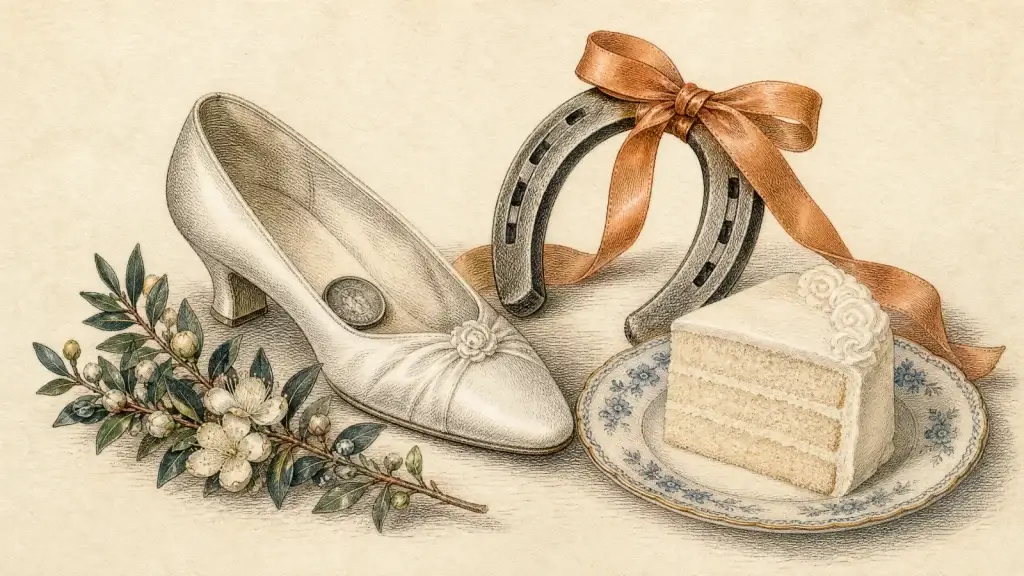
The rhyme “Something old, something new, something borrowed, something blue” comes from nineteenth-century England, and older versions end “and a silver sixpence in her shoe.” Each item is usually explained as a small charm: something old for continuity, something new for the future, something borrowed for the luck of a happy friend, something blue for faithfulness, and the coin for a comfortable life.
Rain on the wedding day
In English-speaking countries, rain on a wedding day is often called bad luck. In Italy the saying runs the other way: sposa bagnata, sposa fortunata, “a wet bride is a lucky bride.” The rain is said to wash things clean, or to promise as many children as there are raindrops, depending on whom you ask.
Not seeing the bride before the ceremony
The custom that the groom shouldn’t see the bride in her dress before the wedding is usually traced to the days of arranged marriages, when keeping the couple apart was thought to stop anyone changing their mind. Today it is mostly kept for the drama of the moment.
Wedding cake under the pillow
In British folklore, an unmarried guest who sleeps with a small piece of wedding cake under the pillow is said to dream of a future spouse. The cake was sometimes passed through a wedding ring first.
St Agnes’ Eve
On the night of January 20, St Agnes’ Eve, young women were said to see their future husbands in a dream if they followed certain rituals, such as going to bed without supper. John Keats made the custom famous in his 1820 poem The Eve of St. Agnes.
Valentine’s Day and the birds
The link between St Valentine’s Day and romance appears in the fourteenth century, in Geoffrey Chaucer’s poem The Parliament of Fowls, where birds gather on “Seynt Valentynes day” to choose their mates. The idea that birds paired off in mid-February became a popular belief, and the day became one for sweethearts.
The daisy game and the apple peel
Pulling petals from a daisy while saying “he loves me, he loves me not” is a game known across Europe; in France it is called effeuiller la marguerite. Another old custom has someone peel an apple in one long strip and throw it over their shoulder: the shape it lands in is said to show the first letter of a future partner’s name.
Why these customs last
Love superstitions turn an uncertain, important part of life into something with rules and rituals, and they make a good story. Most people who keep them do so with a smile, which may be the best way to keep them.
Sources
- Iona Opie and Moira Tatem, A Dictionary of Superstitions, Oxford University Press, 1989.
- Geoffrey Chaucer, The Parliament of Fowls, c. 1380.
- John Keats, The Eve of St. Agnes, 1820.
- Steve Roud, The Penguin Guide to the Superstitions of Britain and Ireland, Penguin, 2003.