At midnight on December 31, half the world is doing something for luck: eating grapes, ringing bells, opening doors, smashing plates. Here are twelve New Year customs, one from each of twelve countries, and the stories behind them.
- Fastest customTwelve grapes in twelve chimes
- LoudestPlates on Danish doorsteps
- Common threadStarting the year as you mean to go on
Key takeaways
- Many New Year customs share one idea: what you do at the turn of the year sets the tone for the rest of it.
- Food, round shapes, coins and loud noise appear again and again across cultures.
- These customs are traditions, kept for fun and for family. They promise nothing.
Spain: twelve grapes
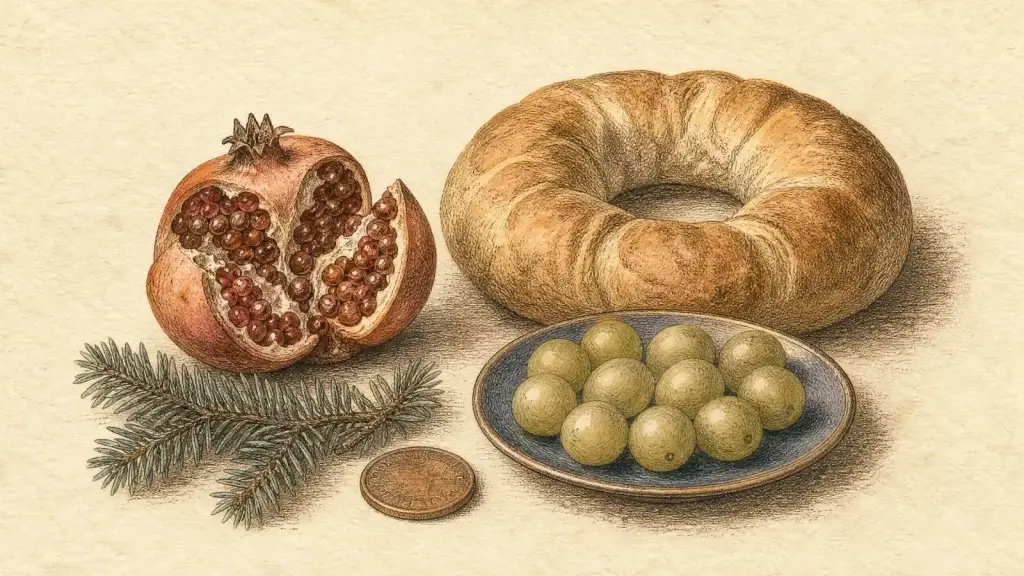
In Spain people eat one grape on each of the twelve chimes of midnight, one for each month of the coming year. Written accounts go back to at least the 1890s in Madrid, and the custom spread widely after a large grape harvest in 1909. Millions watch the clock at Madrid’s Puerta del Sol on television as they eat.
Scotland: first-footing
At Hogmanay, the first person to cross the threshold after midnight is the “first-foot”, and they bring the luck of the year. Tradition favours a tall, dark-haired visitor carrying small gifts such as coal, shortbread or salt.
Japan: 108 bells
Buddhist temples across Japan ring their great bells 108 times on New Year’s Eve in a ceremony called joya no kane. The number is said to match the 108 earthly desires in Buddhist teaching, which the ringing clears away for the new year.
Greece: the coin in the cake
The vasilopita, a cake or sweet bread, is baked with a coin hidden inside and cut at New Year. Whoever finds the coin in their slice is said to have luck for the year.
The Philippines: round fruit
Many Filipino families set out twelve or thirteen kinds of round fruit on New Year’s Eve, round like coins, and some wear clothes with polka dots for the same reason.
Brazil: seven waves
On beaches in Brazil, people dressed in white jump over seven waves at midnight, making a wish with each one. The custom draws on Afro-Brazilian traditions honouring Iemanjá, the goddess of the sea.
Denmark: smashed plates
Danes save old plates and throw them against the doors of friends and family on New Year’s Eve. A big pile of broken china on your doorstep in the morning is a sign of how many friends you have.
The American South: black-eyed peas
In the southern United States, a New Year’s Day plate of black-eyed peas, often with collard greens and cornbread, is traditionally eaten for luck in the year ahead.
Italy: lentils
Italians eat lentils at New Year, often with sausage. The small round lentils are said to look like coins, and the more you eat, the luckier the year.
Colombia: the empty suitcase
In Colombia and other parts of Latin America, some people walk around the block with an empty suitcase at midnight, in the hope of a year full of travel.
Ecuador: burning the old year
Ecuadorians build effigies called años viejos, “old years”, out of old clothes and paper, often shaped like celebrities or politicians, and burn them at midnight to leave the past year behind.
Germany: pouring shapes
Germans have long melted a small piece of metal in a spoon, poured it into cold water and read the year ahead in the shape it made. Lead kits were restricted in the European Union in 2018, and most people now use wax instead.
Starting the year
Few people believe a grape or a plate decides their year. The customs last because they make a night memorable, bring people together, and give the turn of the year a shape. That is luck of a kind.
Sources
- “Twelve Grapes”, Wikipedia. en.wikipedia.org
- donQuijote, “New Year’s Eve in Spain (Nochevieja)”. donquijote.org
- Steve Roud, The Penguin Guide to the Superstitions of Britain and Ireland, Penguin, 2003.